

RS3 Summoning Familiars are pets you summon by consuming a pouch, and they can help you fight, skill, heal, or store items. You can only have one out at a time, so your pick matters. A beaver needs level 33 Summoning, lasts 32 minutes, and gives you an invisible +2 Woodcutting boost, which makes it a natural fit if you chop trees often. A granite lobster needs level 74 Summoning and lasts 48 minutes, adding an invisible +4 Fishing boost and a 3% fishing catch-rate boost on top.
Don’t judge familiars only by their special moves, because some work quietly in the background. The bunyip, which needs level 68 Summoning, passively heals you for 2% of your maximum life points every 15 seconds, so it helps during long fights and grinds. The pack yak, at level 96 Summoning, carries 30 items, and its Winter Storage scroll banks items straight from your backpack. Since a June 2021 update, most durations come in 16-minute steps, and the Anachronia Totem of Summoning adds 16 minutes on top, so you can plan your sessions around the time you have.
Key Takeaways
- If you mostly fight and have reached level 68 Summoning, the bunyip heals you for 2% of your maximum life points every 15 seconds without any clicking.
- If you mostly chop trees, the beaver needs level 33 Summoning, lasts 32 minutes, and gives you an invisible +2 Woodcutting boost.
- If you mostly fish, the granite lobster needs level 74 Summoning, lasts 48 minutes, and gives you an invisible +4 Fishing boost plus a 3% fishing catch-rate boost.
- Each scroll use costs familiar special points, and a standard charged pouch converted at an obelisk gives you 10 scrolls, but those scrolls only work while their matching familiar is summoned.
- The pack yak is only worth its cost once you reach level 96 Summoning and bank often, since its Grand Exchange guide price of 4,059 coins is far above the 321 coins for a spirit wolf pouch.
How Do RS3 Summoning Familiars Work?
A familiar appears when you consume its Summoning pouch, and it stays out until its timer runs out. You can only have one familiar out at a time, so summoning a new one replaces the current one.
Most familiars now last in 16-minute increments. The 14 June 2021 update standardized most durations this way, so a beaver’s 32 minutes is two steps, while a granite lobster’s 48 minutes is three. The Anachronia Totem of Summoning adds another 16 minutes to a familiar’s duration, so a beaver lasts 48 minutes when you use it.
Special moves work differently. Each one is unlocked by a scroll, and you can only use a scroll when its matching familiar is summoned. If you have a beaver out, a unicorn stallion’s scrolls are useless to you. A standard charged pouch can be converted at an obelisk into 10 scrolls. Using a scroll costs familiar special points, not summoning points, so the two resources don’t compete with each other.
Scrolls are what make some familiars useful in a fight. A unicorn stallion’s Healing Aura restores 10% of your maximum life points for 20 familiar special points, and the stallion can also cure poison. A beaver’s Multichop scroll cuts up to three logs from a nearby tree at once, which saves time on a busy woodcutting trip.
Jagex’s Smarter Familiars update from 6 October 2014 made combat life easier. It let familiars store up to 500 special-move scrolls, and combat familiars could use their special moves automatically whenever you had scrolls and summoning points available. You no longer have to babysit every attack.
Some familiars help without a scroll at all. A granite lobster forages raw sharks and swordfish while you fish, and a beaver forages logs and planks for you. You get the extra items just by having the familiar out, so you can keep your hands on the fishing rod or the axe.
Familiars also used to vanish the moment you died, which meant losing your pet and its timer. A 13 November 2023 patch changed that, and familiars no longer despawn when their owner dies. Your pet stays with you after a bad fight, so you can get back to what you were doing.
Which Familiars Help Most in Combat?

The bunyip is the best pick if you want healing that works without any clicking, and the unicorn stallion is the better choice if you can reach level 88 Summoning and want a big heal on demand. Both are built for long fights, where staying alive matters more than high damage output.
The bunyip heals you for 2% of your maximum life points every 15 seconds, all while you keep attacking. That’s four heals a minute, or 8% of your maximum life points. If your maximum is 1,000, each tick gives you 20 life points back, and over a long boss kill that steady trickle can save you from eating food in the middle of a hit. The bunyip lasts 48 minutes, and if you add the Anachronia Totem of Summoning, it lasts 64.
The unicorn stallion needs level 88 Summoning and lasts 64 minutes, so you get a longer window than with the bunyip. Its Healing Aura scroll restores 10% of your maximum life points in one go, which is five times what the bunyip gives you per tick. With a 1,000 maximum, that means 100 life points back at once. The stallion can also cure poison, which is handy against monsters that poison you during a fight.
The trade-off is cost. The Healing Aura scroll uses 20 familiar special points each time, so you need to keep those points topped up. A standard charged pouch can be converted at an obelisk into 10 scrolls, which gives you a limited supply of heals before you need to restock. Plan for that before you head into a tough fight, and bring enough pouches to cover the whole session.
You also can’t run both healers at once, because only one familiar can be summoned at a time. Pick the one that fits your fights. If you mostly grind mobs and want steady background healing, the bunyip is hard to beat. If you tackle bosses and want a burst of healing when a big hit lands, the stallion is the stronger choice, though it needs a higher Summoning level to reach.
Combat familiars can also use their special moves on their own once you have scrolls and summoning points available. Before a fight, summon your familiar, check that you have scrolls in your inventory and enough summoning points, and then focus on your weapon and your position. You can keep an eye on your health bar instead of watching a scroll icon the whole time.
Which Familiar Should You Use for Woodcutting and Fishing?
If you spend most of your time chopping trees or pulling fish from the water, the beaver and the granite lobster are the two familiars to consider first. Each one matches a skill and adds a boost you feel every time you swing an axe or cast a line.
The beaver is the woodcutter’s pick. You need level 33 Summoning to use it, and it lasts 32 minutes. Its invisible +2 Woodcutting boost works in the background, so you don’t have to click anything to benefit from it. The beaver also forages logs and planks while you chop, which means you keep collecting useful wood without stopping to check your inventory.
The beaver’s Multichop scroll is where it really saves time. One use cuts up to three logs from a nearby tree, so you can clear a cluster of trees faster than you could by hand. Scrolls cost familiar special points, so keep an eye on that supply before a long trip.
The granite lobster is built for fishing. It needs level 74 Summoning and lasts 48 minutes. It gives you an invisible +4 Fishing boost and a 3% fishing catch-rate boost, so you land more fish from the same spot. While you fish, it also forages raw sharks and swordfish, which are worth more than the common fish you catch early on. You get those bonus catches without changing how you fish.
The Summoning level for each familiar is a gate, and that makes it easy to plan your training. The beaver’s level 33 is a reasonable first target if you’re still building your Summoning, while the granite lobster’s level 74 is a longer-term goal. Work toward 33 first, then decide whether woodcutting or fishing takes up more of your playtime before you push for 74. Since you can only have one familiar out at a time, picking the gate you can reach next is often the smartest move.
Duration matters too. The Anachronia Totem of Summoning adds 16 minutes to a familiar’s timer, so a beaver can last 48 minutes and a granite lobster can last 64 minutes when you use it. That extra time is useful on longer fishing or woodcutting sessions, where you don’t want your familiar to expire halfway through a good run.
Here’s how the two compare side by side:
- Beaver: level 33 Summoning, 32 minutes, +2 Woodcutting boost, forages logs and planks, Multichop cuts up to three logs
- Granite lobster: level 74 Summoning, 48 minutes, +4 Fishing boost and 3% catch-rate boost, forages raw sharks and swordfish
Is the Pack Yak Worth Its Cost for Banking?
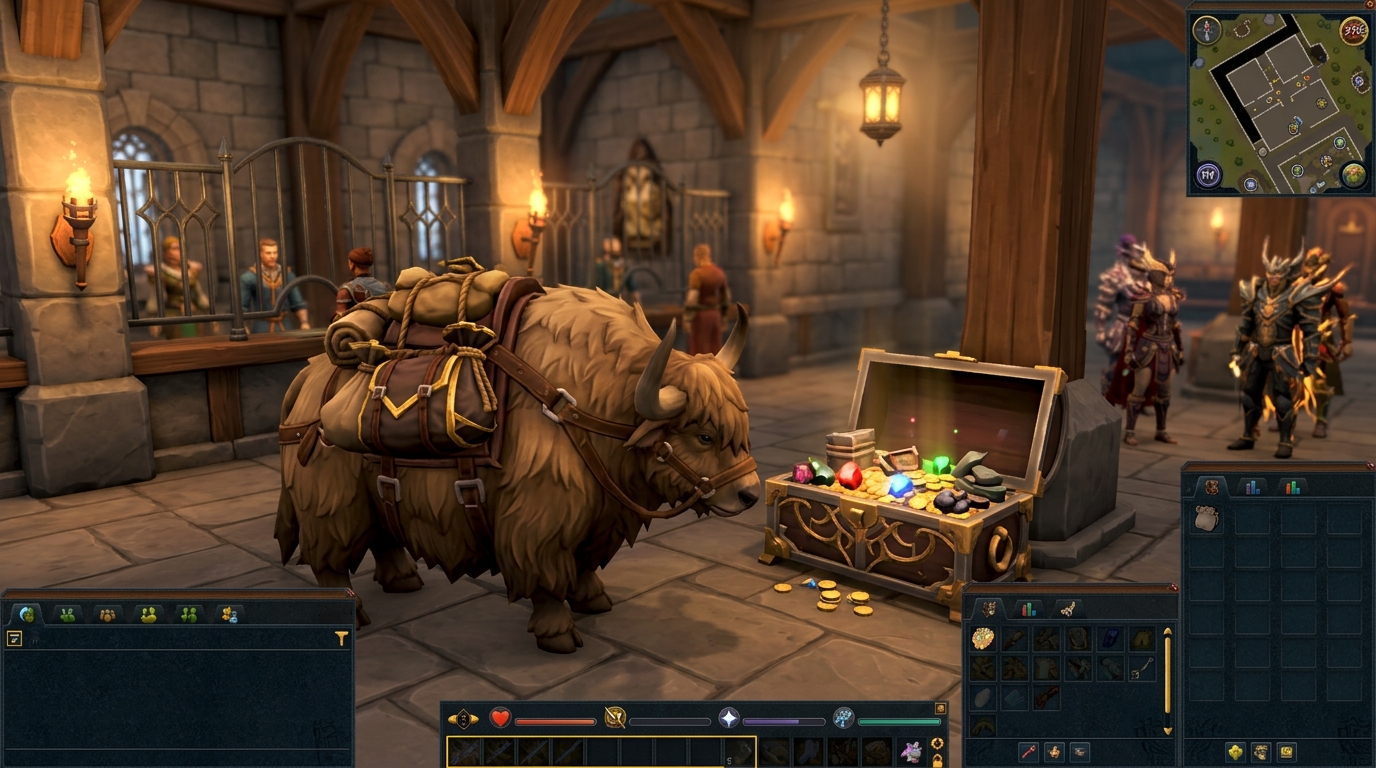
For most players, the pack yak is worth its cost only if you bank often and have reached level 96 Summoning. Once you have it, it lasts 64 minutes and carries 30 items for you, so you can keep working longer before you need to walk to a bank.
Its storage role comes from its Winter Storage scroll. Using that scroll banks an item straight from your backpack, so you can clear space while you keep skilling. On a long trip, where a full backpack would otherwise send you back to the bank again and again, that can save real time.
The limits matter just as much. Winter Storage banks only one item per scroll when you use it on noted items. If your backpack is full of noted logs, ore, or fish, each scroll clears just one stack, so you’ll burn through scrolls quickly. Scrolls also use familiar special points, so you need to keep those topped up as well.
Now for the cost. In the October 2026 price snapshot, the Summoning pouch calculator lists a pack yak pouch as needing 211 spirit shards, with a total creation cost of 5,658 coins. The same snapshot shows Grand Exchange guide prices of 321 coins for a spirit wolf pouch and 4,059 coins for a pack yak pouch. That gap is large, so the pack yak only makes sense if its storage saves you enough trips to justify the spend.
To decide, think about how you play. If you train skills in short sessions near a bank, a cheap familiar with a useful boost may serve you better. If you run long gathering sessions far from a bank, the extra carrying space starts to pay off. Your Summoning level also matters, because you can’t use the pack yak until you reach level 96.
Prices change often, so check the Grand Exchange and the Summoning pouch calculator yourself before you buy. The figures above are a snapshot, and the numbers you see on the day you shop may be different.
How Do Special Moves and Scrolls Actually Work?
Special moves work by converting a charged familiar pouch into scrolls at an obelisk, then using each scroll while its matching familiar is summoned. Each use spends familiar special points, which are a separate resource from summoning points.
A pouch is the item you consume to summon a familiar, and a scroll is the item that unlocks one of its special moves. A standard charged pouch converts into 10 scrolls, so one pouch gives you 10 uses. You can keep your pouches in the bank and convert only the ones you need for the session ahead.
Scrolls and special points work together, so check both before you start. Your familiar’s special points pay for each move, and your summoning points are a different bar that stays untouched when you use a scroll. Keep an eye on the special points, since running dry mid-fight leaves you with scrolls you can’t use.
Familiars can store up to 500 special-move scrolls, which is the equivalent of 50 charged pouches. That capacity lets you stockpile scrolls for a long grind instead of making repeated trips to an obelisk. You’ll still need to convert pouches yourself, because the storage limit doesn’t turn pouches into scrolls automatically.
Here’s the full process from start to finish:
- Charge a standard familiar pouch so it’s ready to convert.
- Take the charged pouch to an obelisk and convert it into 10 scrolls.
- Summon the familiar that matches those scrolls by consuming its Summoning pouch.
- Use a scroll on your summoned familiar to activate its special move.
Notice that the order matters. You can convert scrolls without having the familiar out, but you can’t use them until its matching familiar is summoned. If you have a beaver out, a unicorn stallion’s scrolls sit in your inventory doing nothing.
Since the 13 November 2023 patch, familiars no longer despawn when their owner dies. That means your summoned familiar stays with you after a rough fight, so you don’t have to resummon it and lose the time you spent building up your special points. You can pick up where you left off without starting the summoning process over.
Before a long session, work out how many scrolls you expect to use and convert enough pouches to cover that number. A boss fight where you rely on healing may burn through scrolls faster than a relaxed woodcutting trip, so plan each session around its likely demands. Then check your special points before you leave the bank, and you’ll avoid the frustration of an empty scroll supply halfway through.
Choosing Your First Familiar for RS3

If you mostly fight, the bunyip is the healer to aim for, but it needs level 68 Summoning, so treat it as a goal rather than a first purchase. If you mostly skill, the beaver is the realistic first familiar. Its Woodcutting boost works while you chop, and you can reach its level 33 requirement much sooner. Save the pack yak for later, once you reach level 96 and find yourself making long trips to the bank.
Check the Summoning level before you buy pouches or train for them. A pouch you can’t use yet is just spirit shards and coins sitting in your bank, so train to the requirement first, then buy.
Plan your sessions around the timer. Durations come in 16-minute steps, and the Anachronia Totem of Summoning adds 16 minutes on top. A beaver with the totem lasts 48 minutes, so a 45-minute woodcutting trip fits inside one summon. Decide how long you plan to train, then pick a familiar whose timer covers that time.
Recheck pouch prices before you commit. The figures in the Summoning pouch calculator are a snapshot, and Grand Exchange prices move. The gap between a spirit wolf pouch and a pack yak pouch is large, so a quick look at current guide prices can change which familiar makes sense this week. Confirm the price on the day you shop, then buy the pouch your level and your activity call for.
Planning Your First Familiar Step by Step
Start by checking your Summoning level. Open your skill menu and look at the number next to Summoning. If it’s below 33, your first goal is the beaver, so train up to that level on the activities you already enjoy.
If you’re already at 33 or higher and spend most of your time chopping, buy a beaver pouch before your next woodcutting trip. Its timer is 32 minutes, so consider adding the Anachronia Totem of Summoning if you plan a longer session. Before you leave the bank, convert a charged pouch at an obelisk into 10 scrolls, then check that you have enough familiar special points to use Multichop on the trees you plan to hit.
If you mostly fight and have reached level 68, summon a bunyip and test it on one mob grind. Watch your health bar over a few minutes and notice how steadily it recovers between hits. Write down what you see, then decide whether the stallion’s level 88 requirement is a goal worth chasing. Your own results will tell you more than any guess about which familiar suits your style.