

Training Cooking to level 99 in OSRS takes about 13,034,431 XP, a total that the OSRS Math Team lists. The fastest route depends on how much attention you can give your screen. Fast methods like cooking karambwans from level 30 or making jugs of wine from level 35 can earn you big XP per hour, but they ask you to click quickly and keep each cook moving. Slower methods let you step away more often. You earn less XP per hour, but you also feel less pressure.
Your account decides which fast route is open to you. Karambwans need the Tai Bwo Wannai Trio quest finished before you can cook them successfully, and each successful cook gives 190 XP. Wine only needs level 35 and gives 200 XP per jug.
Key Takeaways
- If you have finished the Tai Bwo Wannai Trio quest, you can cook karambwans from level 30 for 190 XP per successful cook, so check your quest log before you buy any raw karambwan.
- One-tick karambwan cooking is estimated at about 464,000 XP per hour at level 30, while normal, lower-attention karambwan cooking drops to about 141,000 XP per hour at the same level.
- Jugs of wine need level 35 Cooking and give 200 XP per jug, but you should expect a less predictable route between levels 35 and 67, since reliable success starts at level 68.
- Free-to-play and Ironman players can train Cooking on fish from sardines at level 1 up to salmon at level 25 to 30. Quests such as Recipe for Disaster (28,000 XP) and Meat and Greet (8,000 XP) also raise your level without using any food, but check each quest’s requirements before you plan around them.
- Your fish ladder runs from sardines at levels 1 to 5, herring at levels 5 to 10, mackerel at levels 10 to 15, trout at levels 15 to 20, pike at levels 20 to 25, and salmon at levels 25 to 30, so stay with each fish until the next one takes over.
What Is the Fastest Way to 99 Cooking in OSRS?
Cooking to level 99 takes about 13 million XP, and the fastest route is the one that asks the most from your attention. Fast methods can finish the climb in roughly 17 hours of modeled training, but only if you keep every cook moving. Slower methods take longer, but they let you step away from the screen.
Fast methods reward focus. One-tick karambwan cooking, a precise method that keeps your clicks nearly nonstop, is estimated at about 464,000 XP per hour at level 30. Normal, lower-attention karambwan cooking drops to about 141,000 XP per hour at the same level. You give up speed in exchange for a calmer session.
Speed also brings a bigger risk of waste. Every burnt or lost fish is food you paid for that never gave you any XP. The OSRS Wiki’s pay-to-play estimate puts the loss at about 104,000 GP if you turn 500 raw karambwan into poison karambwan and all 500 are wasted. Grand Exchange prices move around, so treat that number as a rough guide, not a fixed cost.
Slower methods make more sense when your goal is profit or your time is limited. You can cook in shorter sessions, check your progress when you return, and accept a lower XP rate in exchange for less pressure on your clicks.
To choose your route, ask yourself two questions. How many hours can you give each session? And how much food can you lose before the training stops feeling worth it? If you have a few focused hours and a steady supply of fish, a fast route suits you. If you prefer to cook while doing something else, a slower route keeps training relaxed and waste low.
Which Food to Cook at Each Cooking Level
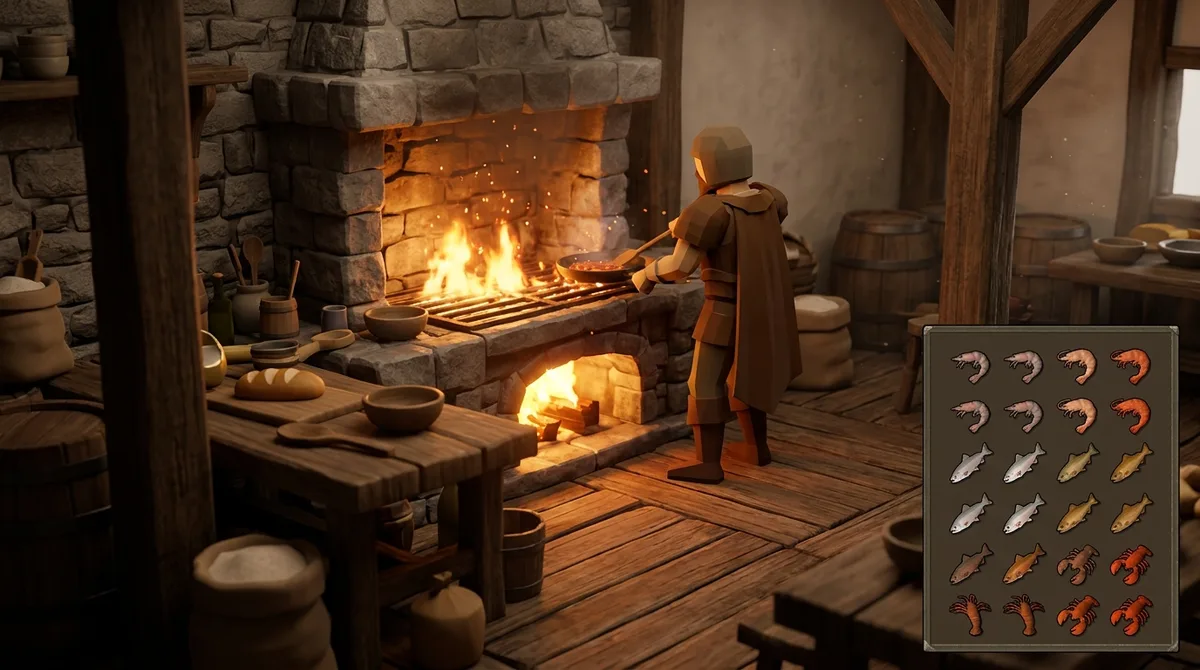
Start at level 1 with sardines, which you can train on until level 5. Once you reach level 5, switch to herring, and keep moving up the ladder as each level comes in:
- Levels 1 to 5: sardines
- Levels 5 to 10: herring
- Levels 10 to 15: mackerel
- Levels 15 to 20: trout
- Levels 20 to 25: pike
- Levels 25 to 30: salmon
Stay with each fish until you hit the level where the next one takes over. Jumping ahead early means you spend more on food for fewer levels, so it pays to be patient on the early rungs.
Level 30 is where karambwan becomes a members’ option, but only after you finish the Tai Bwo Wannai Trio quest. Without that quest done, you cannot cook karambwan successfully, so check your quest log before you buy any raw karambwan. Each successful cook gives 190 XP, which makes it a strong next step after salmon.
Once you are high enough in Cooking, Sailing fish become useful for training. Giant krill at level 69 gives 177.5 XP, haddock at level 73 gives 180 XP, and marlin at level 91 gives 225 XP. Pick the fish that matches your current level, and be ready to switch as soon as you reach the next one on the list.
Between level 30 and the Sailing fish, karambwans and jugs of wine cover most of the middle levels. The next sections explain how to choose between them.
How Do Burn Rates Change as Your Level Rises?
Burn rates drop as your Cooking level rises, so a level 1 cook loses far more food than a level 60 cook does. Burning means the food is ruined, and you get no XP from it.
Burn chance falls as your Cooking level rises, which is why early fish burn so often. At low levels you are still learning the timing, and the game gives you a high chance of ruining each fish. Each new level makes burning less likely, so the sardines that burned often on your first trip are much safer by the time you reach salmon.
Cooking gauntlets help when you cook on a range or a fire. Wear them in your gloves slot and they lower the burn chance, so you lose fewer fish on the same trip. They do not change the XP a successful cook gives. They only protect the food you already paid for.
The Hosidius Kitchen ranges are another way to cut burning. You need the Easy Kourend & Kebos Diary to use them, and they give a 5% increased chance of cooking successfully. Finish the elite diary and that bonus rises to 10%, which helps most when you cook large batches.
Burn rates matter most for expensive raw food. A raw karambwan costs far more than a sardine, so every burnt one hits your bank balance hard. Wine ingredients work the same way, since a bad run wastes the supplies you bought for the batch. Watch how much you lose in each session, and if the number climbs, slow down or switch to cheaper food.
Where Is the Best Place to Cook Near a Bank?

For one-tick karambwan cooking, the best spot is a range with a bank close enough that you can walk there and back in a few steps. Every extra step lowers your XP per hour, and the fastest method depends on keeping that rhythm going. Hosidius is the exception. Its bank is far enough from the kitchen ranges that the longer walk can cut your XP rate by about 10 to 20 percent compared with the fastest locations, so it is not a good pick for one-tick cooking.
That doesn’t mean the Hosidius Kitchen is useless. Its ranges need the Easy Kourend & Kebos Diary, and they give a 5% increased chance of successfully cooking your food. Finish the elite diary and that bonus rises to 10%. You can count on that extra success chance to protect your food when you cook in larger batches.
The Hosidius bonus fits best with steady, lower-attention training. Normal karambwan cooking and jugs of wine suit a relaxed session where you cook, check your chat, and cook again. In those sessions, the longer walk to the bank costs you less, because you are not racing the clock. A higher success chance means fewer burnt fish and fewer wasted ingredients over the whole session.
Before you commit to a spot, walk the route from your bank to the range and time it. Note how many steps you take on each trip and how often you need to restock. If the walk slows you down enough to feel like a chore, move closer to the bank and use the Hosidius bonus only when you are training at a slower pace.
Keep your inventory ready before you leave the bank. Bring enough raw food for one trip, and check that your gauntlets are equipped if you own them. A tidy setup at the start of each trip keeps the session smooth, wherever you train.
Karambwans or Wine: Which Fast Method Fits You?
Pick karambwans if you have finished Tai Bwo Wannai Trio and enjoy fast, precise clicking. Pick jugs of wine if you are at least level 35 and would rather make a steady batch of XP with less pressure on your clicks.
Karambwans give the bigger XP rates when you cook with one-tick timing. That method is estimated at about 464,000 XP per hour at level 30 and about 950,000 XP per hour at level 99. At a slower, lower-attention pace, the estimate drops to about 141,000 XP per hour at level 30 and 273,000 XP per hour at level 99. Each successful cook gives 190 XP, and the modeled one-tick route from level 30 to 99 uses about 75,185 karambwan.
The quickest start is also the riskiest. Cooking about 500 raw karambwan into poison karambwan can get you to level 30 in under 10 minutes. That speed is the appeal, but a bad run can waste a large stack of food before you see much XP.
Jugs of wine need level 35 Cooking and give 200 XP per jug when made successfully. From level 68 onward, the estimated rate is about 470,000 to 490,000 XP per hour. Reliable success starts at level 68, so between levels 35 and 67 the route is less predictable.
Wine costs more to keep running. The OSRS Wiki’s price calculation puts making 62,147 jugs from level 68 to 99 at about 4,101,702 GP, but Grand Exchange prices change, so treat that as a rough estimate. Before you buy a stack of ingredients, check the current prices and decide how much you can spend on a single session.
If you have the quest done and can give your screen steady attention, karambwans offer the highest XP rate. If you want a route that fits a budget you have planned in advance, wine is the better fit once you reach level 68.
Is Cooking Profitable, and What Does Wine Training Cost?
Cooking can give you good XP, but it rarely makes gold unless you pick a method with cheap ingredients and little waste. Early fish training costs very little, since a burnt sardine or herring is a small loss. Karambwans are a different story. If 500 raw karambwan burn into poison karambwan, the OSRS Wiki’s displayed estimate puts the loss at about 104,000 GP, so one bad session can wipe out a lot of gold.
Wine is the most expensive route to run. Making about 62,147 jugs of wine from level 68 to 99 comes to roughly 4,101,702 GP at displayed prices. Treat that as an estimate, not a bill you will pay. Grand Exchange prices change often, and ingredient costs can rise or fall a lot between your first trip and your last.
To compare methods, look at cost per hour, not just XP per hour. Take the XP rate, then estimate how much food you will burn or use in that same hour. A method that gives 470,000 XP per hour but eats through expensive stock may leave you with less gold than a calmer route that costs less per hour. If your goal is XP, a bigger food bill may be fine. If your goal is gold, choose a cheaper fish or a slower method.
Quests are a useful side route because they use no food. The OSRS Wiki’s list of ten quests adds 57,620 total Cooking XP, including 28,000 XP from Recipe for Disaster and 8,000 XP from Meat and Greet. If your budget is tight, finishing those quests first can lift your Cooking level before you spend a single coin on ingredients.
How Can F2P and Ironman Players Train Cooking?
Free-to-play players can train Cooking on fish alone, following the same ladder from sardines to salmon, and you do not need a membership to start. Head to the range in the kitchen of Lumbridge Castle, which sits close to the starting area, so you spend more time cooking and less time walking.
Quests are another route worth planning around, because they add Cooking XP without using any food. Ten quests add 57,620 Cooking XP in total, and two of them carry most of that weight. Recipe for Disaster gives 28,000 XP and Meat and Greet gives 8,000 XP. Check your quest log before you spend coins on fish, because finishing a quest lifts your level without any food cost.
Ironman players cannot buy cooked food from the Grand Exchange or from other players, so the food you cook is your whole supply. The good news is that you can cook your own food while you train. Cook the fish you catch as you go, and keep a stock of cooked food in your bank for fights and long trips.
Stocking up as you train also keeps your skilling from grinding to a halt. Start each session with a full stack of raw fish, and cook it in batches you can afford to lose. Every burnt fish is food you cannot eat and XP you never earned, so a steady rhythm keeps the waste low.
Your Cooking goal, for both free and Ironman accounts, is the Cooking cape, which requires level 99 Cooking. Keep the ladder and the quests in mind, and your food stock will grow alongside your level.
Choosing the Right Cooking Route for Your Account
Free-to-play accounts should stay on the fish ladder, since karambwans are a members’ option. Members who have finished Tai Bwo Wannai Trio can add karambwans at level 30, then try jugs of wine from level 35. Ironman players can follow either path, but they must supply all their own food. Before you buy any raw ingredients, check Grand Exchange prices, because costs can shift a lot from one week to the next. Then ask yourself two things: how many hours you have, and how much food you can afford to lose. A short session on a tight budget suits fish, while a long session with a bigger budget suits karambwans or wine.
Checking Your Account Before You Train
Start by checking your account. Open your Cooking level in the skills tab, then open your quest list and look for Tai Bwo Wannai Trio. That tells you which rung of the ladder you are on and whether karambwans are open to you. Write down your level and quest status before you buy any food.
If you are below level 30 without that quest done, stay on the fish ladder. Cook sardines, herring, mackerel, trout, pike and salmon in order, and come back to the karambwan plan once you reach level 30 with the quest finished. If you already have the quest, try one short karambwan session with a small stack of raw food, then count how many fish burned before you buy more.
Ironman players should set one rule before the first trip: cook in batches you can afford to lose, and keep a stock of cooked food in your bank for long sessions. Once you reach level 35, work out what one session of jugs of wine would cost at current Grand Exchange prices, and compare that number with the gold you can spare.